MET Eikaiwa Tutor · Online English Tutoring
A clear direction for every stage of learning.
From first sounds and shared play to confident academic, everyday, and professional communication, each MET Eikaiwa learning path combines strong foundations, meaningful interaction, creative expression, and practical English use.
The path is structured, but never one-size-fits-all. Age, level, pace, personality, interests, and individual goals guide every lesson.

The destination is clear. The route remains personal.
Teachers may revisit, combine, or extend stages according to readiness and goals.
Strong Foundations
Sounds, vocabulary, grammar, reading, writing, and sentence formation develop step by step.
Meaningful Communication
Learners listen, respond, ask questions, share ideas, and apply English purposefully.
Creative Expression
Stories, role-play, voice, movement, presentation, and performance make language active.
Visible Progress
Practical “Can Do” outcomes help learners and families understand developing ability.
Start with the learner’s current stage and purpose.
Young Children and Parents
For babies, toddlers, and preschool beginners, with parent or caregiver participation when developmentally helpful.
Children first experience English as something safe, joyful, and connected to people they trust. Listening, movement, play, stories, and repeated routines come before pressure to speak.

Connect and Hear
Build trust through familiar routines, songs, movement, and expressive teacher interaction.
Notice and Respond
Connect language with pictures, objects, gestures, feelings, and simple choices.
Build Early Language
Develop useful vocabulary and short patterns for everyday topics.
Express and Grow Together
Use sounds, words, requests, greetings, songs, and home routines with support.
Core Development
- Listening and sound awareness
- Early vocabulary and interaction
- Confidence and participation
- Rhythm, rhyme, and beginning sounds
Typical Activities
- Songs, action games, and movement
- Picture books and puppets
- Pretend play and movement stories
- Matching, choosing, and sound games
Progress is not measured only by how quickly a young child speaks. Attention, gesture, movement, enjoyment, and nonverbal response are meaningful signs of learning.
Elementary Learners
For early and upper elementary learners developing literacy, conversation, confidence, and learning independence.
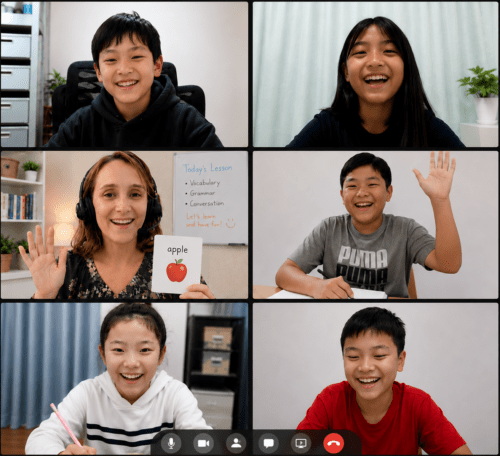
Learners connect sounds, letters, words, sentences, and meaning while using English through games, stories, projects, role-play, reading, writing, and guided conversation.
Engage and Decode
Review familiar language and strengthen sound awareness, phonics, spelling, and pronunciation.
Read and Build
Develop vocabulary, fluency, comprehension, grammar, and sentence formation.
Speak and Create
Use conversation, storytelling, reader’s theater, role-play, projects, and presentations.
Apply and Progress
Use feedback, self-checking, home practice, and practical “Can Do” goals.
Core Development
- Phonics, spelling, and reading fluency
- Vocabulary, grammar, and sentence building
- Listening and conversation
- Paragraph readiness and confidence
Typical Activities
- Games, stories, and guided reading
- Role-play and reader’s theater
- Projects and short presentations
- Creative writing and digital activities
Accuracy and creativity develop together. Children learn how English works while also learning how to communicate, imagine, solve, and share.
Junior and Senior High
For secondary students strengthening school English, independent communication, presentations, interviews, and goal-focused preparation.
Students move beyond short answers toward connected ideas, deeper reading, organized writing, discussion, presentation, and language use suited to academic and future situations.

Assess and Strengthen
Identify current needs and reinforce grammar, vocabulary, pronunciation, and reading strategies.
Read and Organize
Analyze texts and develop paragraphs, summaries, opinions, reports, and essays.
Discuss and Present
Express viewpoints, respond in real time, and build speech, presentation, and audience awareness.
Prepare and Advance
Practice skills required for school, qualifications, interviews, study, and future goals.
Core Development
- Grammar and vocabulary in context
- Reading analysis and listening
- Paragraph and essay writing
- Discussion and presentation
Typical Activities
- Articles, stories, and issue-based tasks
- Discussion, debate, and role-play
- Speech, scene work, and presentation
- Interview and timed task practice
Preparation is not limited to memorizing answers. Students strengthen the underlying language ability needed to understand, organize, respond, and perform confidently.
Adults and Professionals
For adults learning for conversation, travel, work, career development, interviews, presentations, qualifications, or personal goals.
Lessons focus on English that is relevant to the learner’s real life. Accuracy, fluency, confidence, and professional presence develop through guided practice and realistic communication.

Clarify and Strengthen
Define the learner’s purpose and build the vocabulary, grammar, pronunciation, and listening needed.
Build Natural Conversation
Practice initiating, maintaining, clarifying, and closing conversations with greater fluency.
Apply to Real Situations
Use English for travel, social interaction, meetings, interviews, presentations, and workplace tasks.
Refine and Continue
Improve tone, organization, word choice, confidence, and independent learning strategies.
Core Development
- Everyday and professional vocabulary
- Listening, fluency, and pronunciation
- Clear grammar and message organization
- Reading and writing for real purposes
Typical Activities
- Conversation and scenario practice
- Meeting and interview simulations
- Email and presentation coaching
- Role-play, feedback, and refinement
Adult lessons do not follow a fixed textbook route. The learning plan prioritizes the situations the learner must handle and the English needed to handle them successfully.
Expression grows with the learner.
Theater-based learning is adapted to age and purpose. It is not performance for performance’s sake; it is a practical way to develop voice, listening, interpretation, confidence, and communication.
Young Children
Puppets, songs, pretend play, movement stories, facial expression, and simple character interaction.
Elementary
Storytelling, reader’s theater, role-play, dialogue, voice practice, projects, and short presentations.
Secondary
Scene work, speech, debate, interpretation, presentation, audience awareness, and persuasive expression.
Adults
Realistic simulations, interviews, meetings, presentations, negotiation, and confident professional delivery.
What progress looks like at MET Eikaiwa Tutor
Progress is reviewed through practical performance, not only completed pages or remembered words.
Learners develop the ability to…
- Understand increasingly complex spoken and written English.
- Respond with greater accuracy, detail, and independence.
- Use English for age-appropriate personal, academic, or professional purposes.
- Express ideas with clearer voice, organization, and confidence.
- Reflect on feedback and take greater responsibility for learning.
Teachers support progress by…
- Setting practical “Can Do” objectives.
- Adjusting materials, pace, challenge, and support.
- Revisiting foundations and extending learning when ready.
- Sharing useful feedback and next steps.
Find the learning path that begins with the learner.
Tell us the learner’s age, experience, needs, and goals. We will recommend a suitable starting point, lesson length, focus, and learning plan.
© 2026–2027 MET英会話家庭教師. All rights reserved.
Privacy Policy